B.11 Golinsky Mine Case Study
Shasta County, California
Acknowledgements
The mining team would like to acknowledge Christine Brown who submitted the Biochemical Reactors Case Study. The information in this case study is for the Biochemical Reactors used to Treat Mine Influenced Water prepared by the ITRC Mining Team 2013.
B.11.1 Site Information
Contacts
Brad Shipley
U.S. Forest Service
503-478-6185
Name, Location, and Site Description
The Golinsky Copper Mine operated between the 1890’s and the 1930’s, where sulfide ores of copper, zinc and minor amounts of precious metals were mined and smelted on site. The site is located approximately 2 miles from Little Backbone Bay in a remote area near Shasta Lake, California (see Figure B.11-1). Three mine adit portals (Upper Portal, Lower Portal, and Portal 3) discharge mining-influenced water to Little Backbone Creek, which is a tributary to Shasta Lake. The site is at the edge of the Klamath Mountains U.S. Forest Service property and is approximately 20 acres in area. Access is limited to boat and All-Terrain Vehicle (ATV).
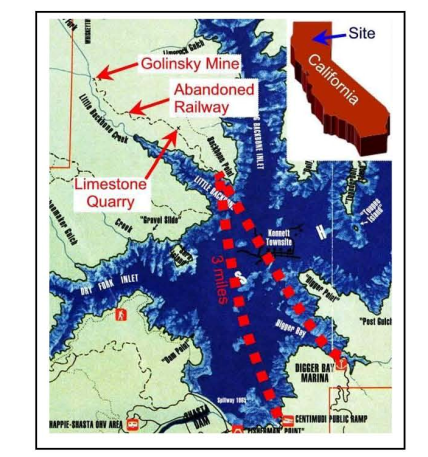
Figure B.11-1. Site location map.
Source: Gusek et al. 2011.
B.11.2 MIW Chemistry
Chemical analyses of the mine discharges revealed that the main mine pool had pH ranging from 2.5 to 4 and contains heavy metals including iron, aluminum, copper, cadmium and manganese (Gusek et al. 2011).
B.11.3 System Design
B.11.3.1 BCR Design
The full system was planned to consist of several BCR cells needed to treat the total flow from the Golinsky mine, and the construction of the system would be implemented in phases to allow for further collection and analysis of data, and challenges to mobilizing a large construction project in a remote location with limited access. The first phase of the system, the module 1 BCR, was constructed in 2010. The system schematic is presented in Figure B-11.2.
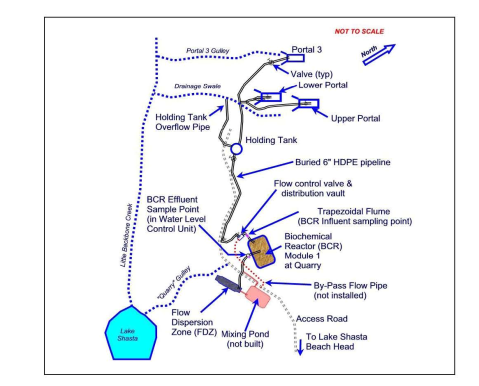
Figure B.11-2. Golinsky BCR System Schematic
Source: Gusek et al. 2011.
One of the unique features of the Golinsky BCR is that the since there was no space to construct the BCR near the mine portals, the BCR was constructed in a limestone quarry approximately 1.5 mile away. A pipeline system was thus constructed to collect the mine discharge and pipe it to the BCR system.
The module 1 BCR cellAn individual unit in a treatment system. is designed to be a vertical flow reactor with flow entering the top of the cell and flowing out the bottom. Flow into the BCR is controlled via a flow distribution vault and trapezoidal flume. The design flow rate is approximately 38 L/min. A design metals removal rate of 0.3 moles/day/m3 was used. The substrateEither (a) a chemical which reacts or (b) a solid surface or (c) an electron donor. consists of rice hulls (10%), wood chips (49.7%), hay (10%), limestone (30%), and manure (0.3%). A total of 1,264 m3 (1,652 yd3) of substrate was added to the BCR. Included in the 0.3% manure was about 1.53 m3 of substrate saved from decommissioning of the pilot-scale reactor, with the belief that microbes present in the pilot substrate, having already adapted to the site conditions, would decrease the time for the BCR to reach maturity.
The module 1 BCR is enclosed by earthen berms within the limestone quarry (see Figure B.11-3).
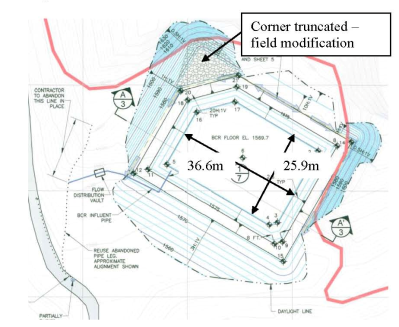
Figure B.11-3. BCR earthwork in limestone quarry.
Source: Gusek et al. 2011.
The organic substrate layer was designed to be 0.9 m thick, underlain by a 150 mm (6-in) gravel drainage layer containing a network of perforated pipes. The pipe network subdivided the floor of the BCR into four equal zones to minimize short circuiting. The final design would include 0.152 m (6-in) of standing water above the substrate and 0.5 m (1.64 ft.) of freeboard. The earthwork was lined with a geomembrane comprised of linear low density polyethylene (LLPDE), 60 mil (1.5 mm) thick. The as-constructed total floor footprint was approximately 3.6% less than design due to local geotechnical conditions. The reduction in theoretical flow capacity of 1.4 L/min falls within the level of confidence in the original design.
B.11.3.2 Pre- and posttreatment requirements
No specific pretreatment processes are needed; the mining-influenced water (MIW) is collected from the three portals by a collection system, which transfers the MIW via gravity to a holding tank. The MIW is conveyed to the BCR approximately 1.5 miles away by a mine water delivery pipeline.
Post treatment consists of discharging the effluent from the BCR into local soils in a flow dispersion zone (FDZ) as shown in Figure 2. The FDZ includes buried infiltration chambers, piping, and drainage gravel. The FDZ further consists of six 20-ft long, 8-ft wide benches that are sloped at approximately 1V:10H and are separated by 2-ft drops at 1H:1V slope. The FDZ follows the approximate hillside contour to the west. The top bench includes a deep zone comprised of three layers of buried infiltration chambers surrounded by riprap.
The pH neutral, metal-free, infiltrated water would travel through the subsurface in bedrock fractures or along the bedrock/colluvial surface before entering Lake Shasta as a nonpoint source.
B.11.4 BCR Performance
The design objectives of the Module 1 BCR are to:
- Remove heavy metals (such as iron, copper, zinc, cadmium) as sulfide precipitates.
- Remove aluminum as a hydroxy-sulfate.
- Remove sulfate by reduction to hydrogen sulfide.
- Maintain the pH at a value of 6 or above by adding alkalinity to the water in the form of bicarbonate.
Preliminary performance data from March 2011 indicated that the BCR removed about 91% of the influent-combined metals load and pH increased from about 2.8 to 6.6. The sulfate reductionThe stripping of oxygen atoms from sulfate (SO₄²⁻), most often yielding sulfide (S²⁻) as an ultimate product. rate was 0.09 moles/day/m3, which was greater than the metals loadingMass of something per time entering a volume (volumetric loading rate) or flowing into an area (areal loading rate). of 0.07 moles/day/m3. These preliminary performance values agree with the pilot BCR data.
B.11.5 BCR Monitoring
Monitoring is conducted at three locations, the BCR influent at the flume or flow distribution vault, the BCR effluent at the Water Level Control Unit, and at the FDZ prior to infiltration into the lowermost portion. The BCR influent is monitored for alkalinity, pH, ORP, conductivity and temperature (field measurements), and laboratory analyses for sulfate, Ca, Mg, and dissolved metals (Al, Fe, Cu, Zn, Cd, Mn). The purpose of monitoring these parameters in the BCR influent is to establish baseline conditions.
The BCR effluent is monitored for these same parameters as well as biological oxygen demand (laboratory measurement). The purpose of measuring Ca and Mg in the effluent is to monitor limestone consumption. The purpose of measuring sulfate and dissolved metals in the effluent is to evaluate metal removal efficiency. The purpose of measuring biological oxygen demand (BOD), alkalinity, pH, ORP conductivity and temperature in the effluent is to evaluate BCR performance.
The FDZ is monitored for the same parameters as the BCR influent, with the purpose of evaluating FDZ performance.
B.11.6 Regulatory Challenges
None reported.
B.11.7 Stakeholder Challenges
None reported.
B.11.8 Other Challenges and Lessons Learned
There were a number of construction challenges. The remote location of the site made selection of a suitable lake-side mobilization site difficult. The solution was to use a United States Forest Service boat ramp, located 4.5 miles away, which added to travel times and prolonged the project schedule.
The construction of the mixing pond was deferred due to construction delays associated with the project. A temporary 25 mm (1-in) reinforced hose was installed to convey BCR effluent from the BCR outfall pipe to the flow dispersion zone. This installation plugged quickly due to apparent damage from a curious bear, as evidenced by telltale bite marks. The hose was subsequently replaced with solid 76 mm (3-in) PVC pipe.
After the BCR was constructed, but before the mining-influenced water could be introduced, seasonal rainfall filled the BCR. To address the problem, flow of Portal 3 water, which had very low concentrations of sulfate (8 mg/L) and no acidity, was introduced. To encourage sulfate-reducing bacteria growth, about 9.1 kg (20 lb.) of Epsom salts were added to the BCR in a single dose and a 13.6 kg (30 lb.) tea bag of gypsum was suspended in the BCR as well. In January 2011, the flow from Portal 3 was disconnected and the flow from the Lower Portal was connected, and the tea bag of agricultural gypsum was removed.
B.11.9 References
Gusek, James J., Kelsey, R. Schipper, and B. Shipley, 2011. Biochemical Reactor Construction and Mine Pool Chemistry Changes, Golinsky Mine, California. Paper was presented at the 2011 National Meeting of the American Society of Mining and Reclamation, Bismarck, ND. Reclamation: Sciences Leading to Success, June 11 - 16, 2011. R.I. Barnhisel (Ed.) Published by ASMR, 3134 Montavesta Rd., Lexington, KY 40502.
Publication Date: November 2013